This information refers to Germany.
Record supply requirements throughout the day
First consider which tasks arise at which times. Basic care, treatment care, documentation, support and handovers are not distributed evenly. Add regularly recurring appointments and well-known features. When planning duty in the inpatient nursing service, the needs can differ between living areas. In the outpatient service, travel routes and the chronological sequence of operations are also taken into account.
Describe the needs by time slot and area before adopting preferred staffing. Check previous assumptions against actual processes. Previous planning is a useful starting point, but it is not evidence that tasks are now equally distributed. Include the employees who carry out this work on a daily basis and can specifically identify bottlenecks.
Distinguish qualifications and responsibilities
A sufficient number of planned people does not say anything about an appropriate distribution of tasks. Record what qualifications, experience or training is required for an area. New employees require training; Trainees need guidance. Such times should not be tacitly treated as fully available supply capacity. Also organize who you can contact if you have technical questions.
Review these requirements for each relevant service. Appropriate early staffing does not automatically compensate for a gap in late shifts. Document in a comprehensible manner what requirements you have used as a basis. The institution must clarify which staffing and staffing are binding based on the applicable regulations. A blanket quota from a general internet template is not sufficient for this.
Calculate actual available working hours
Anyone looking for a net duty roster in nursing often wants to know how much working time really remains for care after absences. Start with the agreed hours and take planned absences such as vacation and training into account. Add a comprehensible basis for the need for representation. The Berlin working aid for outage management emphasizes that your own personnel requirements must first be known.
Do not use a fixed default rate that is unrelated to your institution. Distinguish between already approved absences and statistical assumptions and short-term illnesses. Otherwise there is a risk of double consideration or overly optimistic staffing. Check your calculation regularly with actual data. Net working time describes available capacity; it cannot be equated with a personal hourly account balance.
Plan handovers, breaks and routes visibly
Roster design in the nursing service must also take into account work that occurs between two visible assignments. Handovers require appropriate time and staffing. Breaks need a practical replacement. Realistic travel times are important in outpatient services. In its information on working hours, the BGW expressly points out breaks, handovers and the consideration of travel routes.
An example for control: If both teams use the same handover period, supply must continue to be organized during this time. Enter the overlap so that it remains visible in the lesson plan. Also discuss how late handovers will be handled. Constant overtime at this point may indicate that the planned time window is too tight.
Check night shifts and rest separately
A roster for permanent night guards requires a conscious consideration of the load, as does a changing shift schedule. Requests for fixed night shifts do not replace an examination of working conditions. The BAuA recommends limiting consecutive night shifts as much as possible and avoiding unfavorable shift changes. Also consider the transition between a night block, days off and the next shift.
Don’t just record night work as a number in the monthly financial statements. Check the distribution over longer periods of time and discuss any noticeable exposures with the responsible authorities. Individual free calendar days can offer less relaxation after a midnight shift than the overview initially suggests. Specific start times, end times and the working time law and operational framework conditions are therefore decisive.
Use a unique roster legend
A nursing roster legend should explain abbreviations and times without disclosing unnecessary personal information. For example, you can define F for early shift, S for late shift, and N for night shift. The specific times are included. These are operational specifications, not universally valid abbreviations. Make a clear distinction between vacation, training, compensatory time off and other absences.
Don't let the roster legend grow independently of the templates. If a shift time changes, all associated displays must be adjusted. Also check who can see what information. A publicly accessible notice requires different consideration than personal employee access. Colors may be supportive, but should never be the sole identification of a duty type or absence.
Absorb failures with a coordinated procedure
Determine how an outage is reported, who checks the supply and what representation options exist. A coordinated procedure can take into account internal reserves, a jumper service or other agreed solutions. It is crucial that responsibility is known. Freelance employees are not an automatically available reserve. Even a short-term replacement must fit the task in terms of expertise and time.
Then determine why replanning was necessary. Repeated outages in the same time window may indicate a structural problem. Additionally, consider how often people are approached during planned free times. This creates a basis for improvement rather than just saving the next day. A reliable process also protects planning from becoming dependent on individual, particularly committed employees.
Checklist for roster design in nursing
Check before approval: Are the supply requirements, qualifications and responsibilities correct? Are absences and training taken into account? Are handovers, breaks and routes realistic? Are the service consequences appropriate? Have requests been answered, open gaps clarified and abbreviations clear? Is it clear which plan was published? This checklist complements the technical specifications of your institution and should be further developed together with the team.
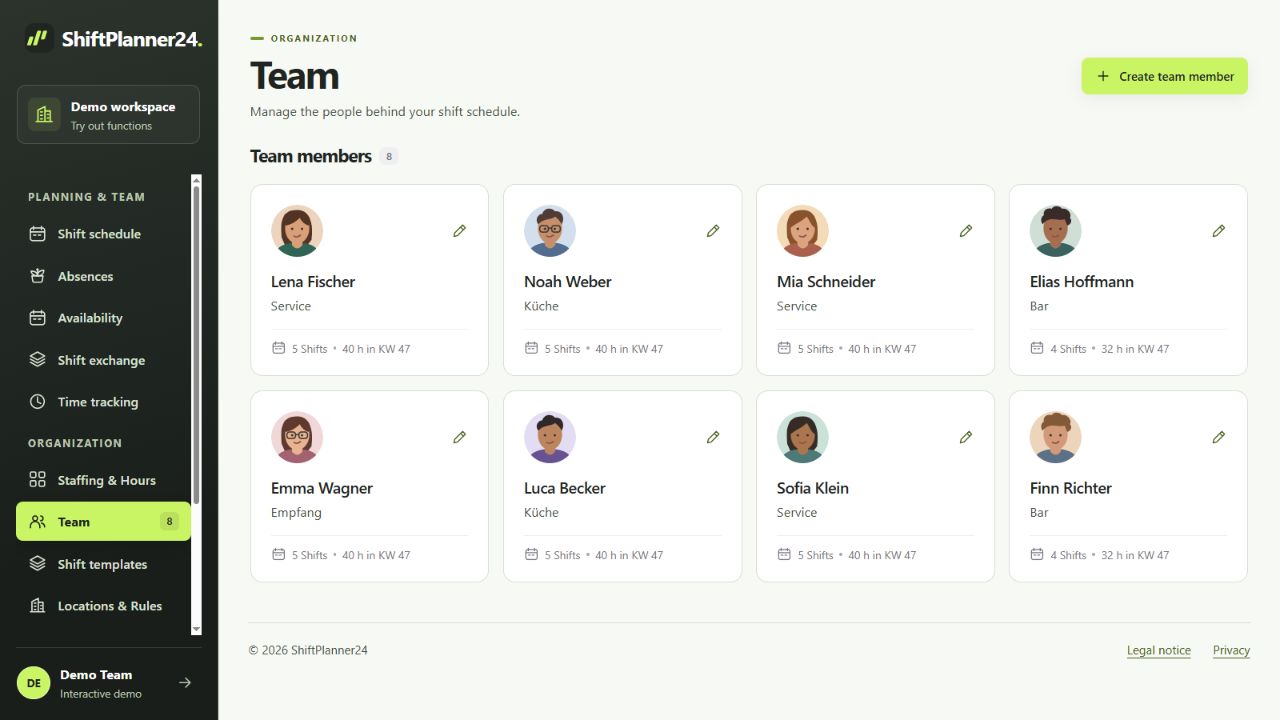
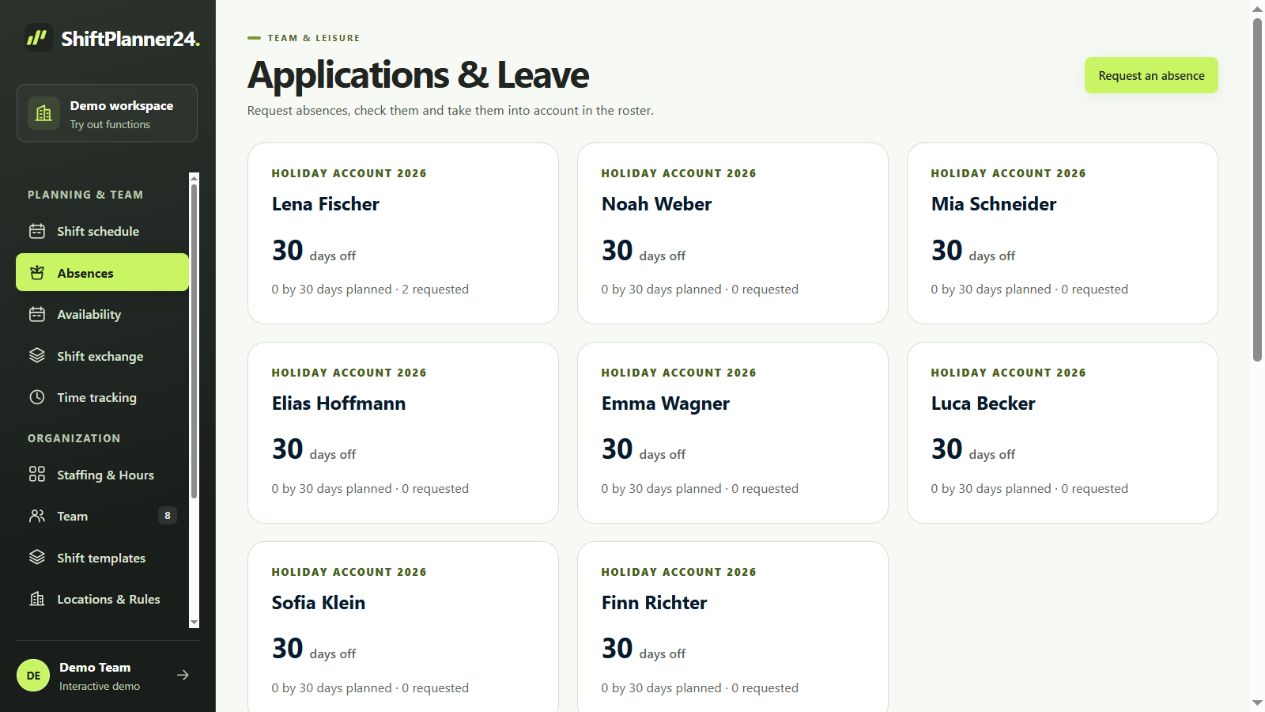
ShiftPlanner24 supports this process with areas, qualifications, availability and separate drafts. You can check planning suggestions before taking over. Published personal services can be confirmed and subscribed to in the calendar. Planned and approved actual times are available for review. Start with a manageable area and first check whether your technical planning assumptions are clearly depicted.
A joint review after the first month of planning shows which information is missing and which rules need to be more precise. Record the agreed adjustments in writing for the next planning.
Sources and further information
Editorially reviewed on November 18, 2026.