Clearly structure guarding and planning responsibilities
First determine which guards and areas will be planned in your work area. Use unique names that employees know in everyday life. Locations help to differentiate responsibilities. For individual planners, access can be restricted to specific locations, while administration manages the overall work area.
An emergency medical services rostering program should support the organization rather than mask unclear responsibilities. Therefore, agree on who determines requirements, who edits the draft and who approves changes. You can use filters to check individual areas. You then check the connection with other assignments by the same people so that a local change does not create a temporal overlap elsewhere.
An exemplary week with two guards is suitable for a joint test. One person is away for training, another only has a limited time slot available. First check the open duties of each guard and then the entire classification of the people concerned. Discuss who can decide on changes across locations and how the new version will be made known. These questions are particularly helpful when multiple planners are involved. A clear plan does not solve responsibility issues by itself, but it does make their effects easier to recognize. Therefore, keep the agreed process accessible to representatives. Check regularly whether this process remains understandable even in the event of short-term changes.
Consider service needs and qualifications together
Describe the required personnel requirements per period and area before assigning specific people. Deposit the qualifications that are relevant to your planning. A free time in the calendar alone does not say anything about whether a person can be used for a specific task. The professional suitability must match the intended activity.
Rule-based scheduling suggestions can take into account needs, qualifications, availability, wishes and hour distribution. You check the suggestions in a preview and decide whether to accept them. This does not guarantee mathematically optimal or automatically legally compliant planning. Control through responsible planning remains a necessary part of the process, especially when requirements change.
Check duty roster models for the emergency services
If you are looking for a twelve-hour duty schedule or a twenty-four-hour duty schedule, you will need more than one completed template. The specific permissibility and design depend on the applicable rules and actual conditions. A long work shift should therefore not be considered suitable simply because of a suitable calendar display.
ShiftPlanner24 can map individual time periods and work shifts beyond midnight. Frequent times can be saved as templates and recurring sequences can be prepared as rhythms. Check such a sample technically and legally before using it. Also distinguish between different forms of work as far as they are relevant to your organization. The planner supports the presentation, but is not a substitute for checking the specific service model.
Plan handoffs and recurring rhythms
From an organizational point of view, a work shift does not always end with a single glance at the clock. Take into account the actual planned handovers and tasks before or after the regular deployment period. Set appropriate start times and end times. Clear templates prevent necessary time windows from having to be added from memory every time a new plan is made.
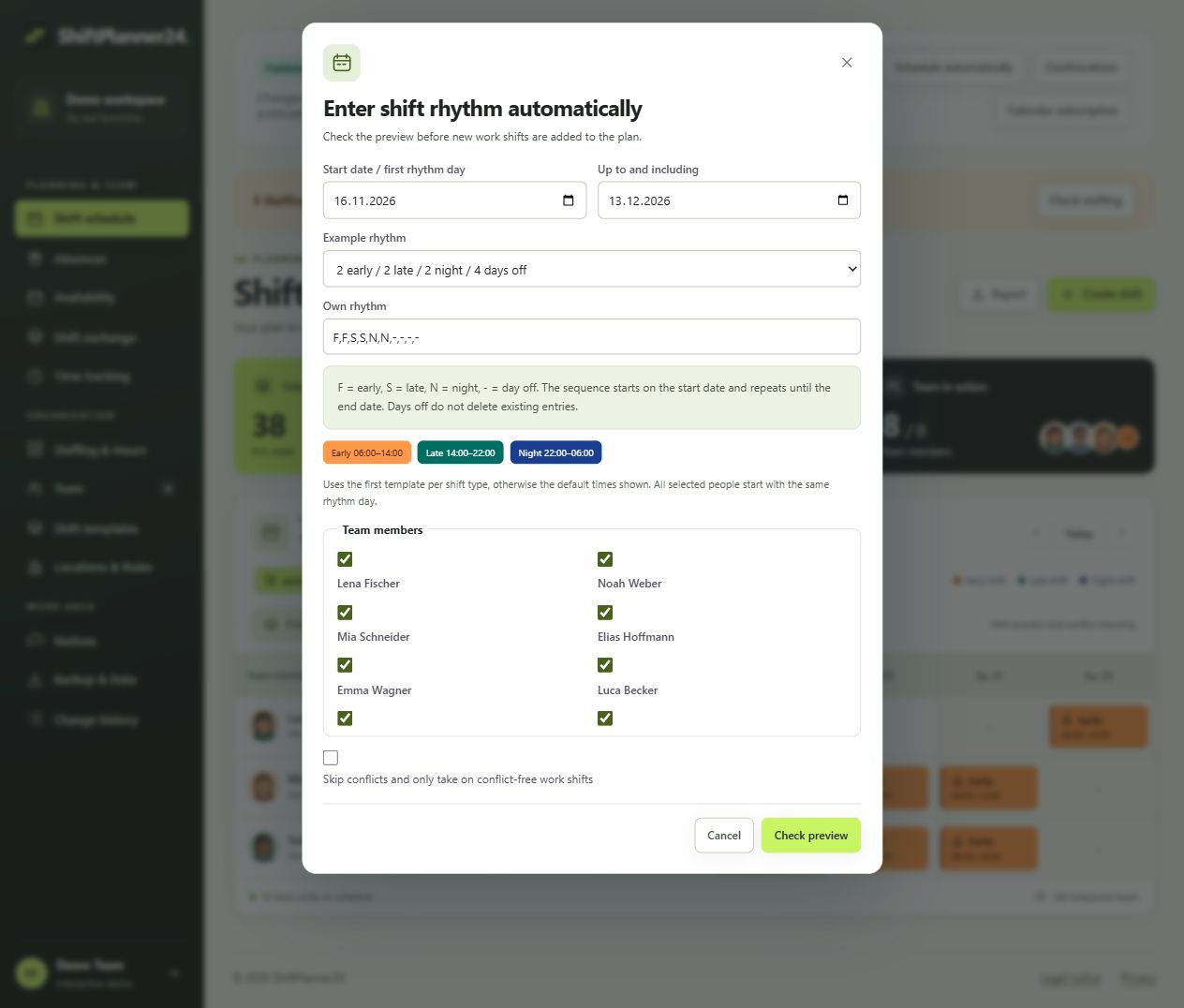
Recurring rhythms help build longer periods of time. After a preview, corresponding shifts can be entered. Then check holidays, absences and changed requirements. Even a copied week needs this check. A general roster is an organizational basis that must be adapted to the actual conditions in a specific period of time.
Process short-term failures in a comprehensible manner
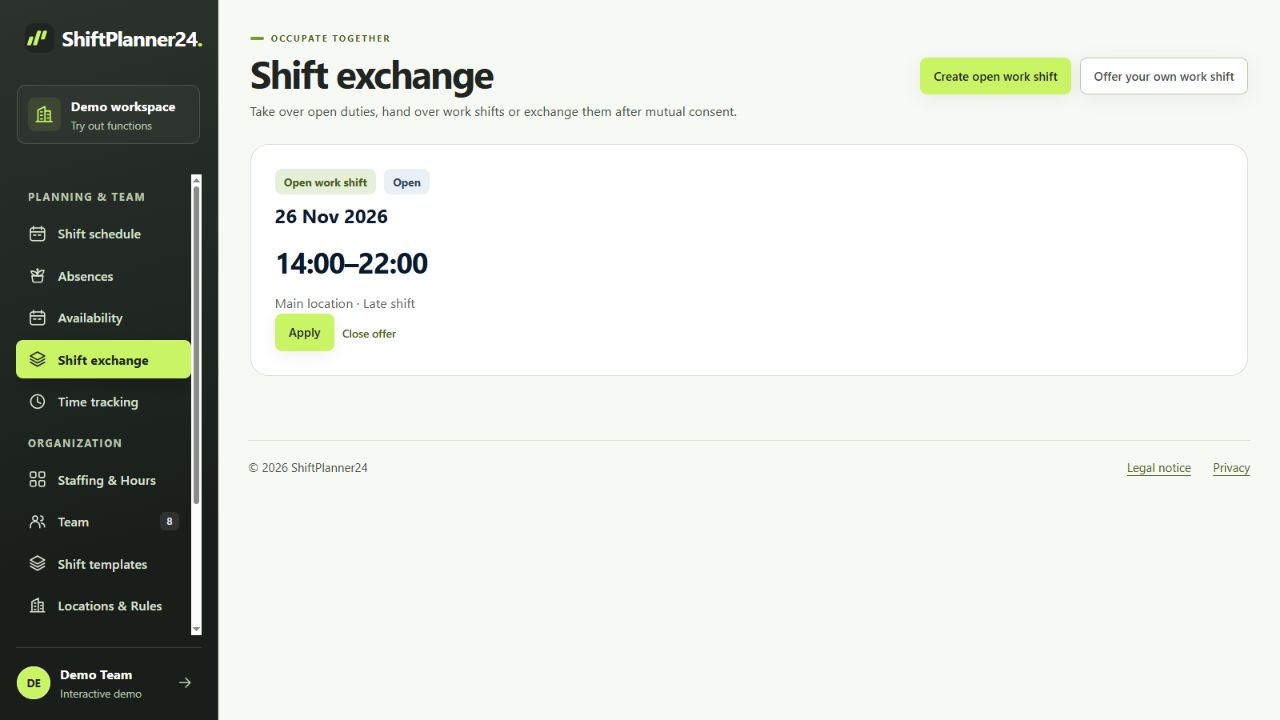
In the case of a short-term absence, first check the service concerned and its requirements. What qualifications are needed, what period is open and which people are actually available? A common overview helps to consider these questions in context. Open services can then be offered via the shift exchange.
Handovers and mutual shift exchanges follow a planned approval process. Both employees agree to a mutual exchange; planning releases the change. Before taking over, the application checks, among other things, collisions, unavailability and stored limits. The responsible person continues to assess the technical staffing and the impact on the rest of the roster.
Share the shared plan with the team
Draft and published roster remain separate. This allows you to prepare a period without treating every interim change as a finished division. After publication, employees can see their personal services via their own access. Plan confirmations support an overview of who has already confirmed the status.
ShiftPlanner24 runs in the browser on computers and smartphones and can be installed as a web app. Personal calendar subscriptions complement access to published services. Your refresh interval is determined by the external calendar service. For short-term changes, use the current plan view and the agreed communication channels. The software does not replace emergency alerts or operational systems intended for this purpose.
Document actual times separately
Planned working hours and actual work performed may differ. Using a time clock, manual entries and corrections, actual working times are recorded separately from the roster. Releases create a controlled transition into the evaluation. Hourly accounts take released times into account based on the stored settings. Breaks are not automatically deducted.
Check open entries and deviations regularly with the responsible people. PDF and CSV support further control. The general CSV wage export provides released actual times for downstream processes. You should check whether the format suits your administration before introducing it. This does not guarantee a direct connection to the deployment documentation or to a specific payroll.
Practically test a demarcated area
To get started, choose a manageable planning area and a complete time period. Create the required guards, qualifications and work shift templates. Then test the path from draft to publication. Add an absence and a swap so that the test also takes changes into account. Use the demo with fictitious data to get to know each other for the first time.
30 free trial days begin in your own work area after email confirmation. A paid continuation only takes place after express booking and costs 19 euros per month including VAT. Collect feedback from planning and the team. What is crucial is whether the rostering in the rescue service clearly reflects your responsibilities and whether the necessary checks take place reliably in the new process.