This information refers to Germany.
What rules determine the roster?
According to Section 106 of the Trade Code, the employer can specify the working hours in more detail, provided that the law, employment contract, works agreement or applicable collective agreement do not already specify these. In doing so, he must appropriately weigh up the interests of both sides. A company need for personnel therefore does not automatically override agreed working time limits or personal interests worthy of protection.
Before planning, check which weekly hours, working times and work locations have been agreed. Record known restrictions and approved absences. Formal requirements for a service plan should also include responsibility, time period, clear services and a traceable publication status. This organizational clarity helps in the application of the respective agreements; it does not replace their legal assessment.
Sources: § 106 GewO: Right to issue instructions and equitable discretion
Consider working time and occupational safety together
The Working Hours Act and the Occupational Safety and Health Act fulfill different tasks. Section 3 ArbZG generally limits working hours on weekdays to eight hours. An extension to a maximum of ten hours requires that an average of eight hours per working day be maintained within six calendar months or 24 weeks. There are further regulations for night work and certain special cases.
The Occupational Safety and Health Act, on the other hand, requires, among other things, the assessment of work-related risks. Section 5 ArbSchG also mentions the organization of working hours and psychological stress. Occupational safety in the duty roster therefore includes more than simply adhering to daily hour limits: stressful consequences of duty and inadequate rest also deserve attention.
Sources: § 3 ArbZG: working hours on weekdays · § 5 ArbSchG: Risk assessment
Plan breaks and rest periods specifically
According to § 4 ArbZG, a total of at least 30 minutes of break is provided for working hours of more than six to nine hours; if more than nine hours, at least 45 minutes. Individual break periods must last at least 15 minutes. In principle, employees are not allowed to work longer than six hours without a break. Therefore, also plan the necessary replacement during the break.
Section 5 ArbZG generally requires eleven uninterrupted hours of rest between two working days. For certain facilities, including hospitals and nursing facilities, the law contains limited exceptions with compensatory obligations. A change from late service to early service therefore requires a concrete examination; a free calendar cell is not enough.
Sources: § 4 ArbZG: Rest breaks · § 5 ArbZG: Rest period and limited exceptions
Roster: When does it have to be ready?
For all employment relationships, there is no uniform legal deadline after which every monthly roster must be published. In particular, collective agreements, employment contracts, works agreements or service agreements can be decisive. Check these basics before communicating a fixed publication date as binding. Regardless of this, an early published roster supports the private planning of your employees.
The often mentioned four-day period applies to work on call according to Section 12 TzBfG. In principle, notification is required at least four days in advance within the specified time frame; Tariff deviations are possible under legal conditions. Do not apply this special rule to every work shift model or every duty roster in nursing without checking it.
Sources: § 106 GewO: Right to issue instructions and equitable discretion · § 12 TzBfG: Work on call and advance notice
Organize changes and co-determination in a comprehensible manner
A published plan should be a reliable basis in everyday life. Whether a later change is permissible depends on the specific agreements, the right to issue instructions and the interests taken into account. Absences due to illness do not automatically make every short-term arrangement legal. Document the reason, the services affected, the vote and the subsequently published version.
If there is a works council, Section 87 Paragraph 1 Number 2 BetrVG is particularly relevant: It concerns the start, end and breaks of daily working hours as well as their distribution over the weekdays, unless there is a statutory or collective agreement regulation. Temporary changes to working hours can also trigger co-determination. Involve the responsible representative in the defined process in a timely manner.
Sources: § 106 GewO: Right to issue instructions and equitable discretion · Section 87 BetrVG: Co-determination
Legal basis for the duty roster in nursing
A duty roster regulation in nursing must take care and the rights of the employees into account together. § 10 ArbZG allows working on Sundays and public holidays, among other things, in hospitals and nursing and care facilities. This means that neither working time limits nor compensation obligations are eliminated. Section 11 ArbZG regulates in particular substitute rest days; possible deviating regulations must be examined separately.
For a nursing facility, you should also clarify which personnel and professional requirements apply to the specific area. Carefully distinguish actual work performance, on-call duty and on-call duty. It is not possible to reliably determine how working hours are treated from the name of a service alone.
Sources: § 10 ArbZG: Sunday and public holiday employment · § 11 ArbZG: Compensation for work on Sundays and public holidays
AVR Caritas and public service
For a roster according to AVR Caritas, it depends on the version that actually applies, the personal scope of application and additional regulations. It is therefore not possible to give a general answer to when a roster must be ready for all church institutions with the same deadline. Check the relevant regulations and the participation rights of the employee representatives.
A roster in the public service also requires a look at the specific employment relationship. Collective bargaining employees and civil servants are not always subject to the same regulations. For federal agencies, Section 80 BPersVG contains co-determination rights regarding working hours; For states and municipalities, the relevant state regulations must be observed. Do not adopt rules from another provider without checking them.
Sources: German Caritas Association: Resolutions of the Labor Law Commission · § 80 BPersVG: Co-determination in federal departments
Distinguish between planned times and actual working times
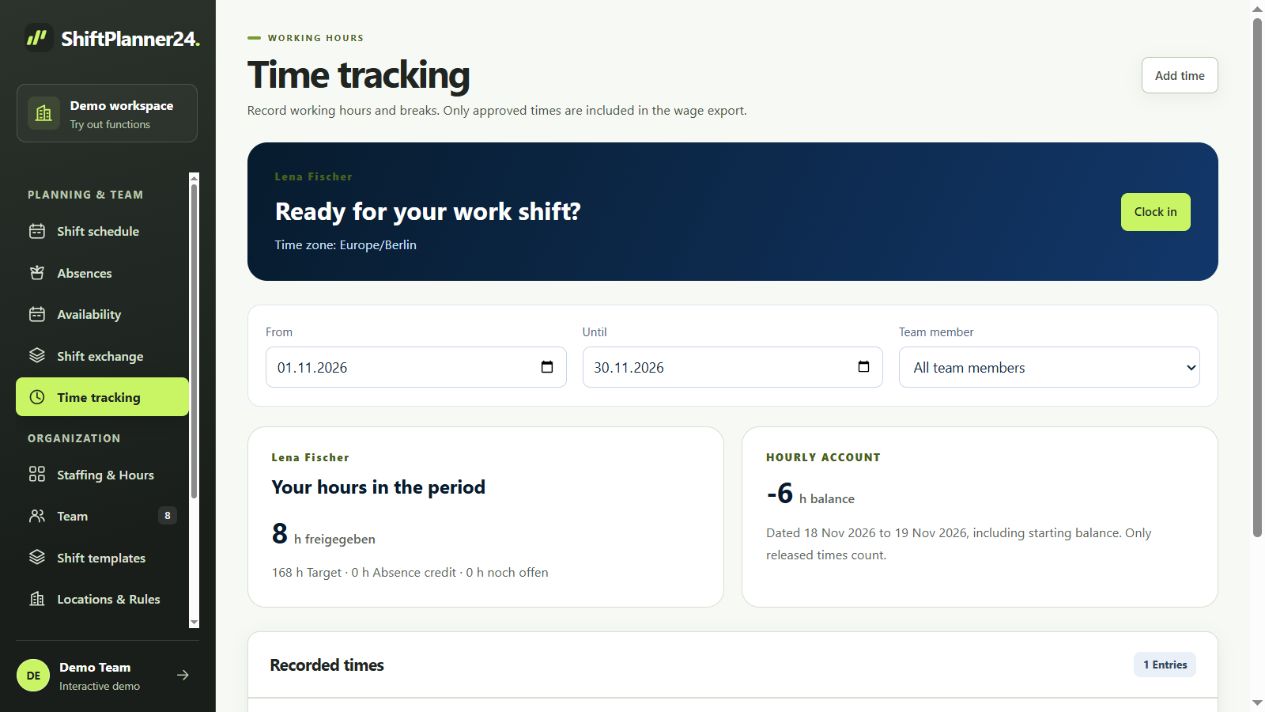
The roster shows the intended distribution of work. It does not automatically document when someone actually worked or took a break. In decision 1 ABR 22/21, the Federal Labor Court derived the obligation to record the start and end of daily working hours for the employees covered from the Occupational Safety and Health Act.
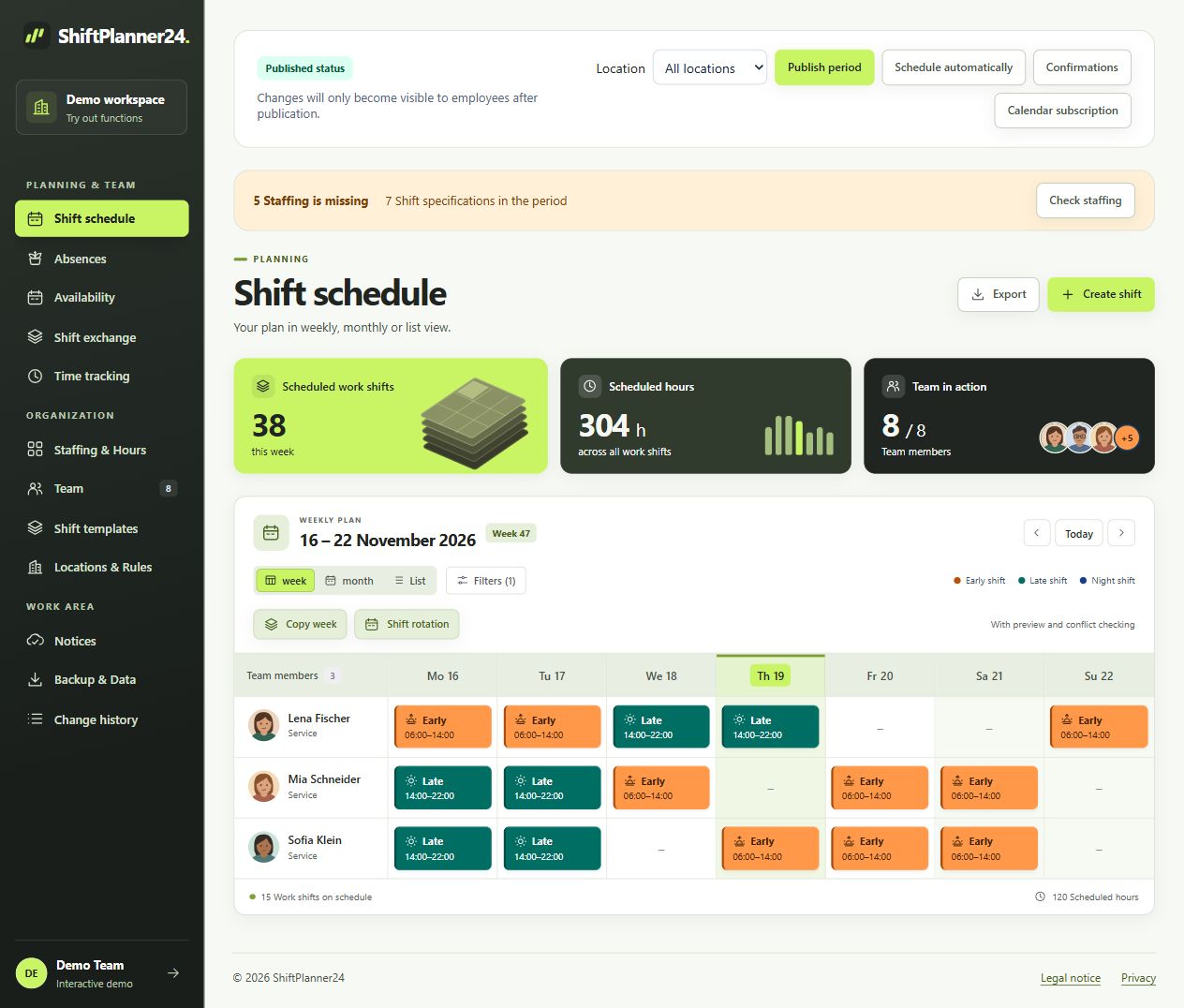
With ShiftPlanner24 you can edit planning, published services and time tracking separately. Breaks, corrections and approvals are part of the documented process. Planning suggestions and information support your review, but do not guarantee legal compliance. Determine who will handle anomalies, which rules will be checked and when the responsible person will approve the plan.
Sources: Federal Labor Court, September 13, 2022, 1 ABR 22/21
Checklist for the next plan release
Start with an overview of the applicable contracts and agreements. Then compare the plan with the agreed weekly hours, approved absences and required qualifications. Check individual shift sequences across monthly boundaries so that the transition from the last to the first planning day is not overlooked. Record break replacements, compensatory times and the required participation steps.
Before publishing, check whether all employees can clearly identify their services. Name a contact person for questions and changes. Mark outdated versions so that no one works from an old expression. Discuss recurring planning problems regularly with those responsible. In this way, individual tests become fixed processes that your team can follow in their everyday work. Responsibilities remain visible even for representatives.
Sources and further information
Editorially reviewed on November 18, 2026.
- § 106 GewO: Right to issue instructions and equitable discretion
- § 3 ArbZG: working hours on weekdays
- § 5 ArbSchG: Risk assessment
- § 4 ArbZG: Rest breaks
- § 5 ArbZG: Rest period and limited exceptions
- § 12 TzBfG: Work on call and advance notice
- Section 87 BetrVG: Co-determination
- § 10 ArbZG: Sunday and public holiday employment
- § 11 ArbZG: Compensation for work on Sundays and public holidays
- German Caritas Association: Resolutions of the Labor Law Commission
- § 80 BPersVG: Co-determination in federal departments
- Federal Labor Court, September 13, 2022, 1 ABR 22/21