What the framework determines and what remains open
A framework plan can describe recurring working hours, typical staffing levels and fixed sequences. How detailed it is depends on your organization. Some companies work with group-based patterns, others with recurring personal basic plans. It is crucial that everyone involved knows what information the template contains and what adjustments are still required.
A framework service plan in nursing care can, for example, provide for various services for living areas. Approved vacation, further training or changed requirements are only taken into account during the specific monthly planning. The frame must not obscure such information. Therefore, clearly indicate whether a view shows a basic template, an editable draft, or the published plan. This distinction prevents misunderstandings within the team.
How rolling planning works
A rotating roster repeats a defined sequence. After the last day of the cycle, the pattern begins again. If the cycle length and calendar week do not match, services will shift from the days of the week. This is precisely why a rolling week cannot be reliably represented by simply copying the same calendar week. The starting date and position in the cycle must be known.
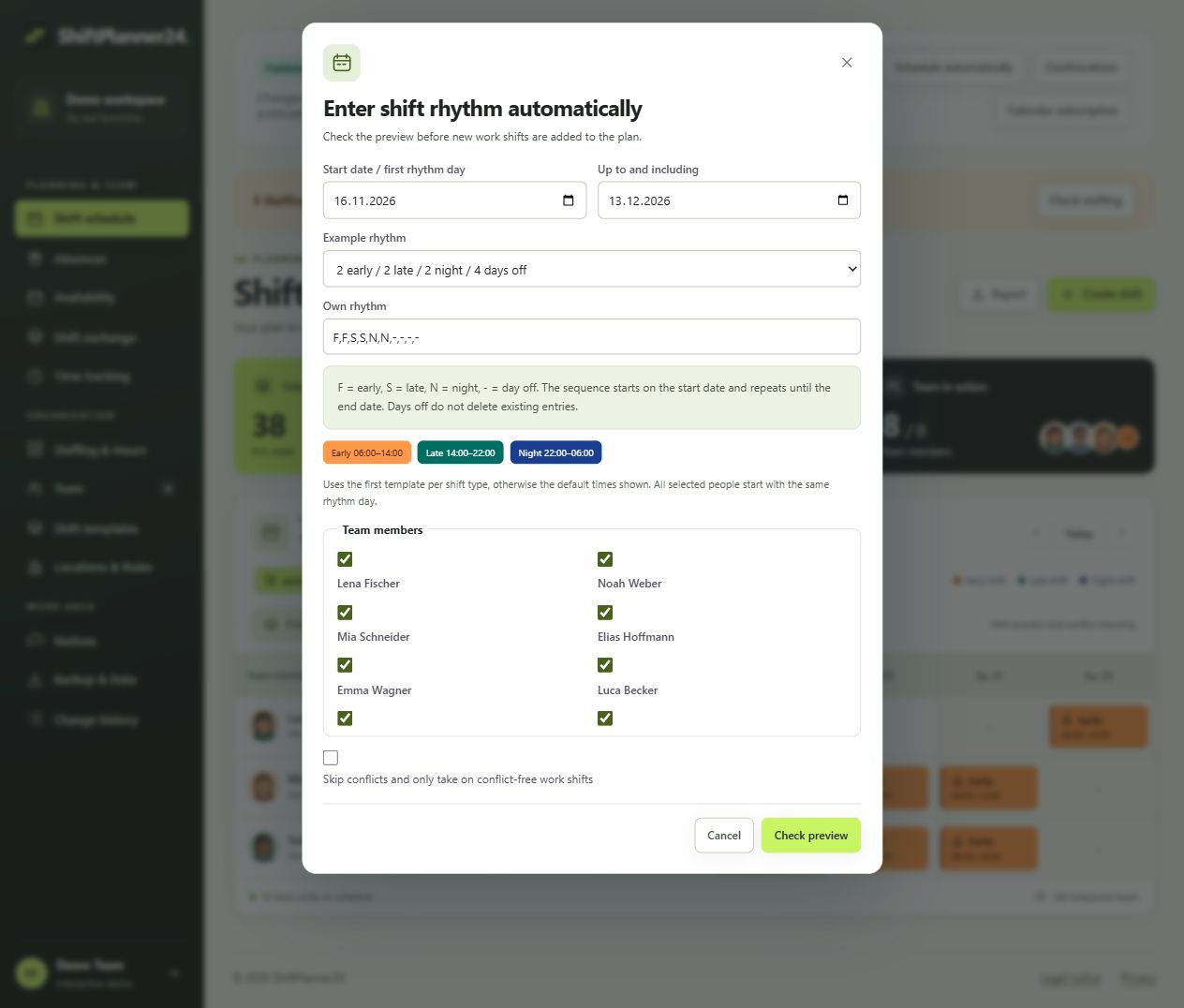
A simplified example of mechanics is a sequence of two early shifts, two late shifts and several days off. Other groups start at a different time. This example explains rotation only and is not a complete staffing plan. Only the joint examination of all groups shows whether the required operations are covered. Individual plans that look the same can still contain gaps.
Determine the need before the rhythm
Start with the required time frames and qualifications. Describe what tasks need to be completed on weekdays, weekends and holidays. Also note fixed dates, handovers and areas with different requirements. Only then can it be assessed whether a recurring rhythm makes sense or whether individual services need to be planned more flexibly.
Compare demand with available contract hours and realistic absences. A plan may be complete on paper despite lacking the necessary representation. The Federal and Railway Accident Insurance describes internal and external representation options for this. Which solution is right depends on your organization. A reserve must actually be available, suitable and coordinated; it is not created by a free table cell.
Build the complete cycle in a comprehensible manner
Set a shift type or day off for each cycle day. Store specific times for each shift type. Then assign groups or people to the starting positions. First check staffing over a complete cycle without any deviations. If partial cycles are of different lengths, you need a sufficiently large common observation period so that all combinations are visible.
Also check the transition from the end of the cycle to the beginning again. This is where unfavorable service consequences can arise. Consider not just weekly hours, but hours in the complete pattern and their distribution across the calendar. A rolling shift plan is only understandable if it can be explained to each person where they start and how the sequence continues afterwards.
Apply a framework service plan in nursing
In a nursing care framework, the recurring services must match the care. Check qualifications and responsibilities per area instead of just looking at the number of people. Handovers, training and instructions take time. An unchanged pattern should therefore not automatically be transferred to another ward, another living area or an outpatient care service.
A rolling nursing roster can make regular service sequences visible and support advance planning. At the same time, individual working time agreements and approved absences must be taken into account. Discuss with the team which parts reliably recur and where adjustments are necessary. General plannability does not arise from the fact that as little as possible can be changed, but rather from the fact that changes follow a comprehensible procedure.
Incorporate vacations and changes in a controlled manner
First transfer the basic pattern as a draft to the specific period. Then enter known absences and agreed changes. Maintain the connection to the basic model: A one-time replacement should not unintentionally shift the entire future rhythm. Determine when someone returns to the intended cycle position after a deviation.
The same logic applies to a rolling roster in Excel. Formulas must distinguish between date, cycle day and individual exceptions. Pay particular attention to monthly changes and manually overwritten cells. A digital planning interface can make processing clearer, but does not make the decision about professionally suitable replacements for you. A change therefore requires the same checks as an originally planned work shift.
Evaluate stress and suitability for everyday use
Don't evaluate rolling work shift models solely based on how easy they are to repeat. The BGW recommends reliable planning and employee participation. Consider free weekends, short rotations, the length of continuous work blocks and the handling of night work. The basic pattern should take into account the actual workload and be checked against the applicable requirements.
Test the plan over several complete cycles before making a final assessment of its quality. Ask for specific feedback: Where do exchange requests regularly arise? Which transitions are difficult to implement? When is representation missing? Such observations are more helpful than a general assessment of the calendar. Record which changes have been made to the model and from what date a new version applies.
Prepare recurring rhythms with ShiftPlanner24
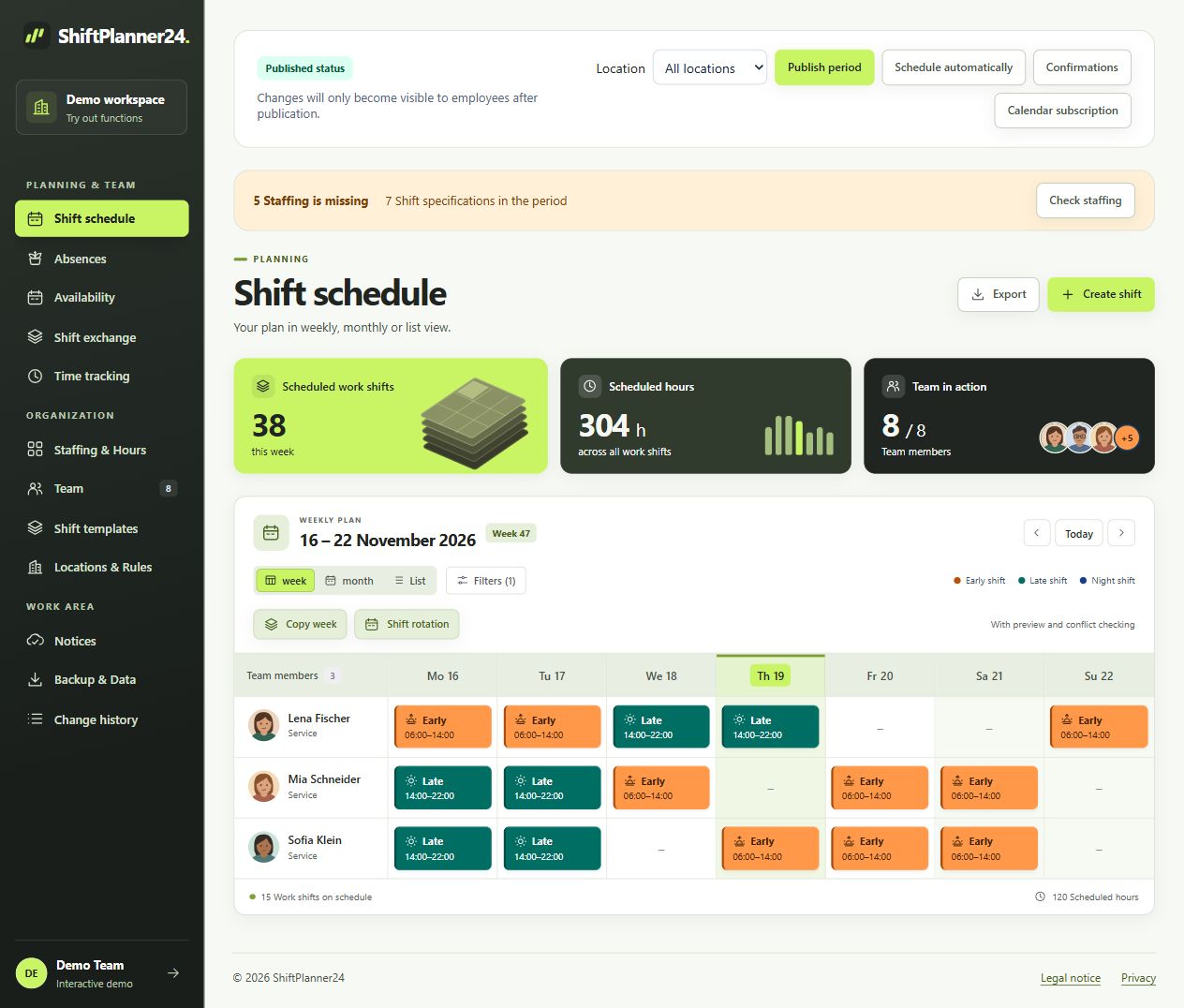
In ShiftPlanner24 you store the required shift times as templates and prepare recurring rhythms. Before you enter you will see a preview. Check the time period, people and shift sequence there. Fixed rhythms are to be distinguished from rule-based planning suggestions: The rhythm repeats a pattern, while suggestions take various stored requirements into account. Both require a final check.
After taking over, you add absences and necessary adjustments to the draft. Publish the verified plan first. Employees see their personal published services and can subscribe to them in the calendar. Start with a limited period of time, compare basic patterns and results and check the cycle limits. This means that recurring planning remains comprehensible, even if individual assignments have to be staffed differently in everyday life.
Keep the description of the basic pattern. This includes start date, cycle length, shift times and the assignment of groups. A representative planner can use this to check whether a deviation is intentional or results from an incorrect transfer of the pattern to the calendar.
Sources and further information
Editorially reviewed on November 18, 2026.