Keep shift types and shift groups apart
A shift type refers to a time window, for example early shift, late shift or night shift. A shift group, on the other hand, refers to a team that works according to a certain rhythm. The terms are often mixed up in everyday life. The so-called 4-work shift model or 5-work shift model often involves four or five groups that cover three daily shift types. Four groups do not mean four daily work blocks.
The BAuA guidelines differentiate accordingly between operating mode, shift duration and number of shift employees. Write down these characteristics separately for each model you consider. Add the length of the complete cycle and the planned weekly working hours. Only this information makes different proposals comparable. A mere name like Konti-Schiftplan is not enough for a reliable selection.
Two work shifts for extended operating hours
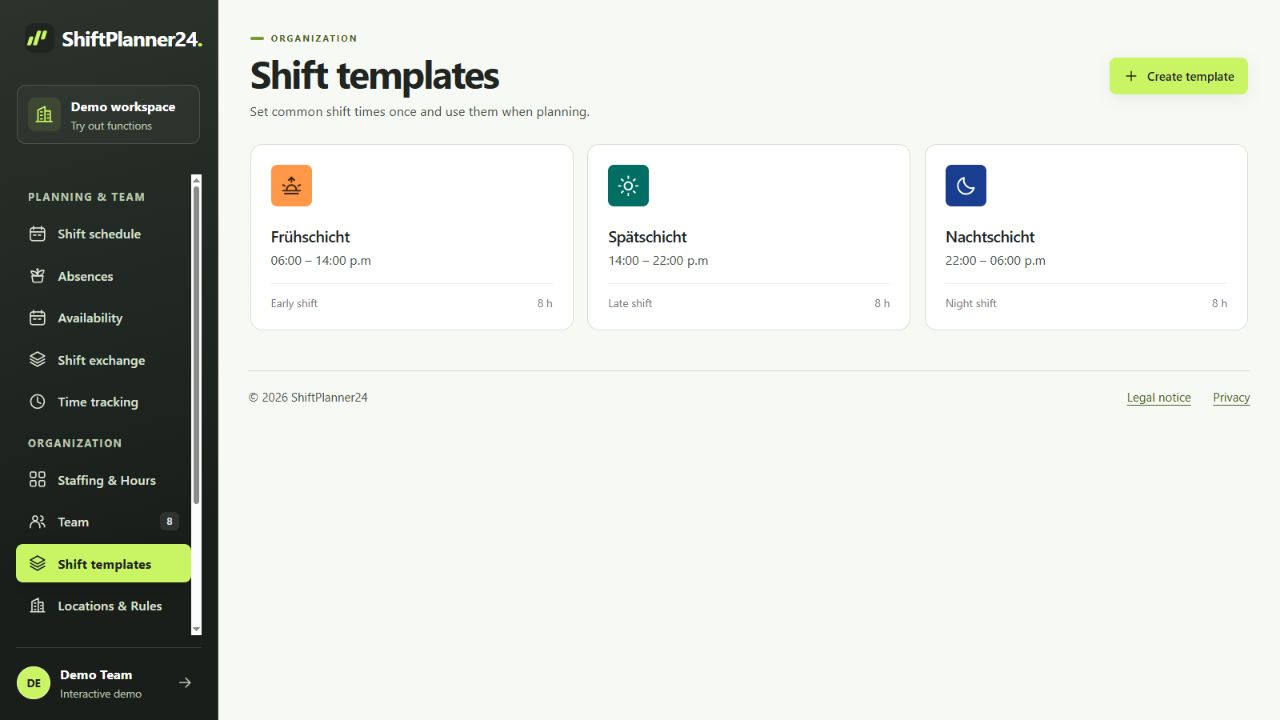
A 2-shift schedule often covers two consecutive day periods. This could be, for example, an early shift and a late shift. The actual times are crucial: two work shifts neither have to be the same length nor do they necessarily have to involve night work. Pay particular attention to preparation, handovers and finishing work when calculating coverage.
Work shift models with two work shifts over five days differ significantly from an organization over seven days. If you work on weekends, you also need a comprehensible distribution of days off and suitable replacements. Therefore, don't start with a finished calendar, but rather with the required staffing hours. Then determine how many groups and contract hours are required for reliable coverage.
Three work shifts and different operating days
A 3-shift model typically includes early, late and night shifts. Whether this results in a complete day-to-day operation depends on the duration, overlaps and break organization. If you want to create a 3-shift schedule, take into account the specific times. Three nominally eight-hour time windows do not yet answer who will take on necessary tasks during handovers and breaks.
A 3-shift model for five operating days is not a plan that can be used unchanged for a whole week. A 3-work shift model over seven days requires a different distribution of work and leisure blocks. Also distinguish between operating time and personal working time: the company can remain open at night while individual teams have time off. The complete cycle must make these differences visible.
Four or five groups in continuous operation
In a 4-shift model for a seven-day week, the services are often divided into four groups. Three groups cover different types of shifts, while the remaining group has time off depending on the cycle. The exact rotation determines what work blocks, weekends and rest look like. There is therefore no one universal shift plan for a 4-work shift system.
A 5-work shift model can open up additional scope for free times, other weekly working hours or planned reserves. Whether this succeeds depends on group sizes and staffing requirements. More groups does not automatically mean more available staff. Compare models across the entire cycle and take vacation, further training and the need for replacement into account. A mathematically suitable basic plan can remain unstable in everyday life without these additions.
Twelve hours, four days and other special forms
A 12-hour work shift model is often associated with fewer handovers or longer blocks of free time. However, these possible characteristics are not sufficient to judge its suitability. Work intensity, breaks, night time and legal requirements must be checked for the specific assignment. A 12-hour or 24-hour shift schedule is not a generally acceptable standard solution.
A work shift model for the four-day week also needs a precise definition. Are weekly hours reduced or spread over fewer days? How do opening times remain covered? What are the consequences for part-time workers? A 40-hour shift schedule and a model with shorter weekly working hours may look similar on the outside, but have completely different organizational requirements. Therefore, always compare hours and workload, not just free calendar days.
Evaluate shift sequences according to their load
The BAuA names short night blocks, favorable shift sequences and sufficient coherent rest as important design approaches. A forward rotation goes from early to late to night. The recommendations must be taken into account in the specific design together with the relevant legal and operational rules. A plan should also remain predictable so that employees can organize their personal lives.
Check individual transitions more closely than the overall color of a calendar. Changes at cycle boundaries in particular are easily overlooked. Include the employees in the assessment and record practical problems, such as early shifts that are difficult to reach or frequently interrupted blocks of free time. Personal wishes are important information, but do not replace an assessment of the working conditions or a review of the respective specifications.
Create a suitable work shift model step by step
First note down the operating days and staffing requirements for each time slot. Add necessary qualifications, available contract hours and foreseeable absences. Then choose appropriate shift types and design several possible cycles. Compare coverage, hourly distribution, duty sequences, free weekends and replacement options for each variant. A clearly documented comparison makes it understandable why one model is preferred.
Test the selected rhythm on a realistic period of time with public holidays and vacation. A 24/7 shift schedule must also work in such weeks. Then agree on a limited testing period and specific criteria for the review. This can include unplanned reshuffles or additional hours that arise on a regular basis. Changes to the model should be based on these observations and agreed upon together.
From model to concrete roster
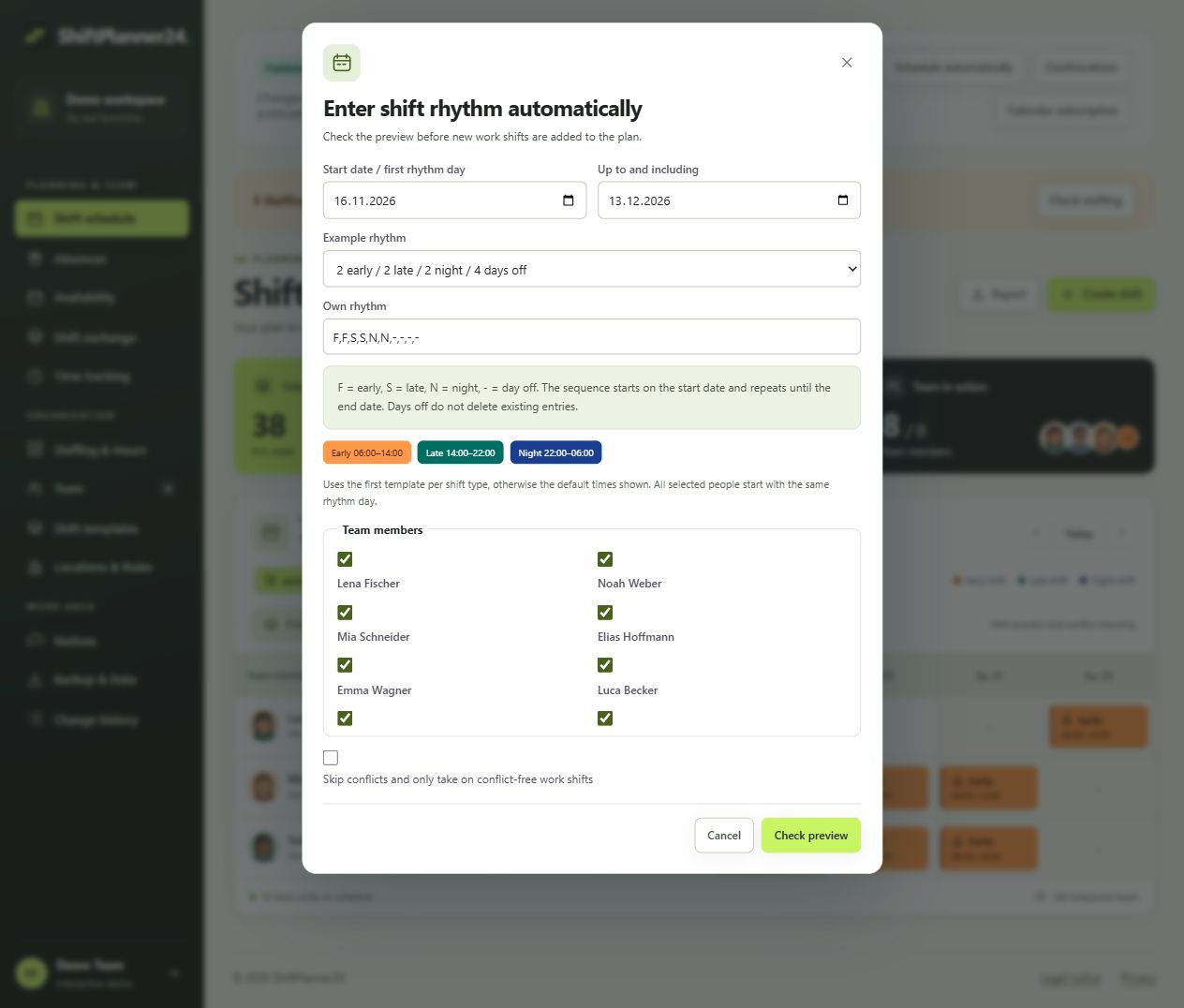
A work shift model is the basis, the published roster is the concrete allocation to people and days. In ShiftPlanner24 you can prepare recurring shift rhythms and view their entry in advance. Areas, qualifications and availability help with further planning. Rule-based suggestions remain controllable; they are no guarantee for an optimal or legally compliant result.
After the takeover, check the entire period and the connections to the previous plan. Compare the actual implementation with your original model later. If many individual corrections are repeated, the basic rhythm should be checked. A theoretical shift sequence develops into a comprehensible planning process whose assumptions you can explain, test and, if necessary, specifically change.
To do this, keep a simple comparison list with the most important assumptions. Notes operating days, shift times, group sizes and planned substitutions. Add the reasons for changes and the date of the next review. This will allow you to see later whether a problem arose from the selected model or from changed conditions. This distinction makes it much easier to make targeted improvements during ongoing operations.
Sources and further information
Editorially reviewed on November 18, 2026.